
Know thyself. Nothing in excess.
Both were carved at the Temple of Apollo at Delphi. The first asks each of us to start with ourselves. The second is the oldest statement of the in-between.
The Alliance's philosophy is that unity forms in the in-between, where opposing ideas meet. It asks each person to practice seven principles. Underneath them are three ideas from Jack H. Meyer's book: self-responsibility, the common interest, and the long term.
Three ideas underneath
Self-responsibility.
Each person chooses who they become and answers for it. Upbringing shapes us, but it does not decide us.The common interest.
Special interests have their place, but the common interest comes first. No part is larger than the whole.The long term.
Jack's test is simple: project any policy twenty years ahead and ask whether the numbers still work.
To these Jack adds the will to act, which he calls looking to the Good. He also holds that truth is good until further notice: we follow the evidence, and we stay open to being wrong.
Seven principles
Think for yourself.
We affirm the simple truth Socrates taught: the unexamined life is not worth living. A free and thriving society depends on citizens who think deeply, question honestly and choose wisely. That begins by setting aside our assumptions long enough to see what is really there.
Take responsibility.
We believe in the dignity of personal responsibility. Mind your own business and focus your energy on the duties that are yours to fulfill. Do the best you can every day, without comparison or resentment. Refuse to be offended, for a people constantly provoked cannot build a nation grounded in unity and reason.
Give the benefit of the doubt.
The benefit of the doubt is a powerful political force; it is the first step toward mutual respect. Do less talking and more listening. Focus on solutions and compromise, not on political power and personal wealth.
Honor the courage of truth.
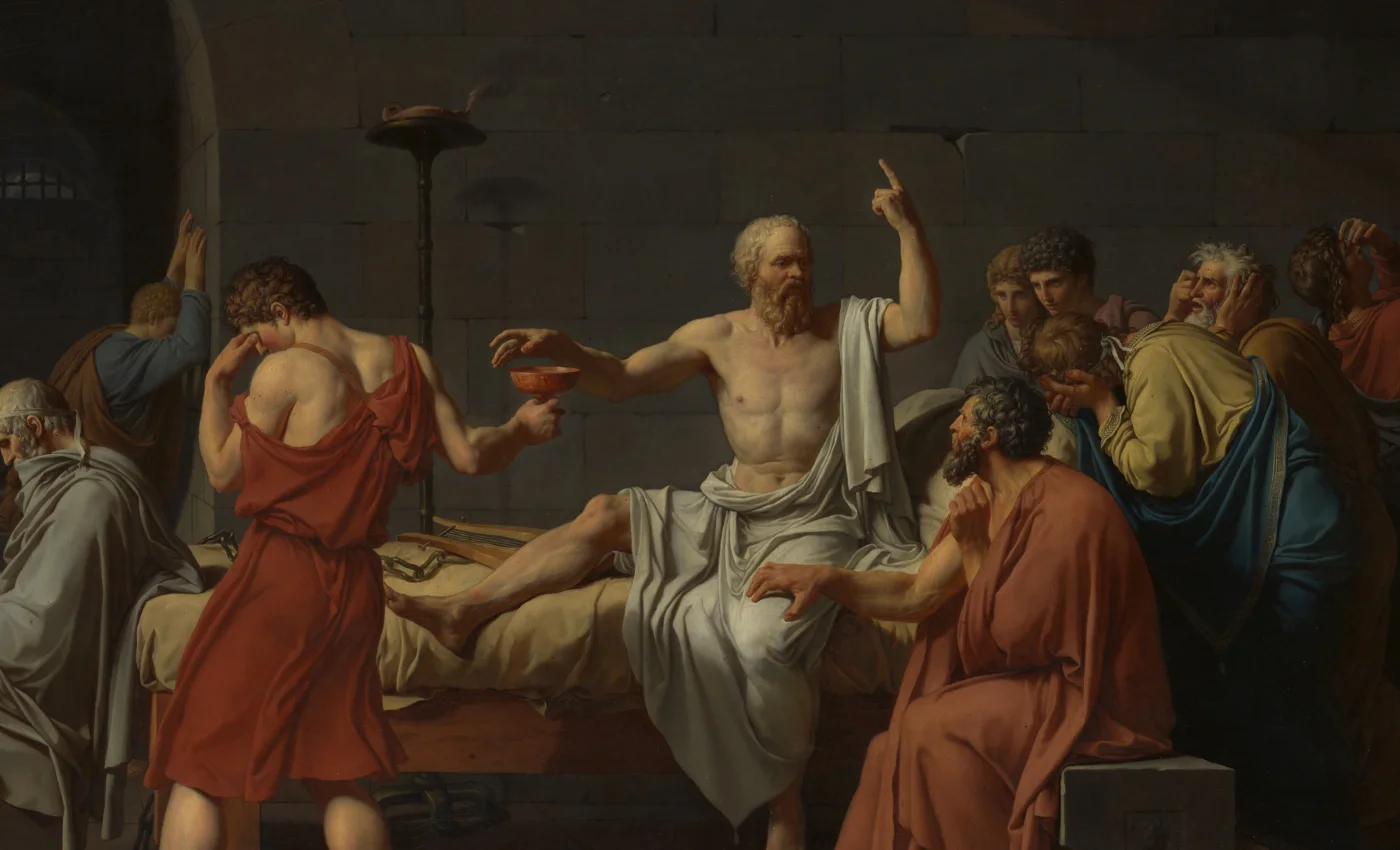
In ancient Greece, in a time of war, the oracle at Delphi named Socrates the wisest man alive, yet Athens put him to death. His courage teaches us that wisdom is not always welcome, but it is always needed. The power of thought is the foundation of human freedom. As Descartes wrote two thousand years later: I think, therefore I am.
Seek justice through integrity.
A fair society is built more on character than on endless disputes, so we seek resolution before litigation. Philosophy teaches that justice begins in the soul and radiates outward to the community. Humanity meets in the recognition of soul to soul.
Balance left and right.
Conservative and liberal ideas each hold part of the truth. Neither ideology alone can govern a free people well. Seeing the short term and the long term, the special interest and the common interest, together is where real solutions begin. Balancing them has untried potential.
Embrace the in-between, patiently.
We reject haste, outrage and reaction. Never be in a hurry: truth and goodness grow in patience. We honor the spiritual heritage that sustains moral clarity, through prayer, reflection or contemplation, and we seek wisdom beyond data alone. In the in-between, where opposing ideas meet and citizens with different views stand together for the common good, unity is formed and consensus becomes possible.